

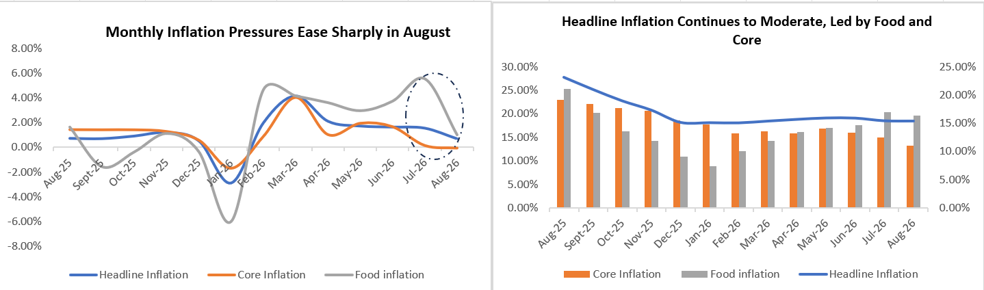
The August CPI numbers released by NBS shows that headline inflation moderated marginally to 15.39% y/y in August, from 15.43% in July. While the 4bps decline in the annual rate was modest, the more significant development was the sharp moderation in MoM inflation, which slowed to 0.71% from 1.57%. This indicates a meaningful easing in the pace of prices increase during the month.
The moderation was driven largely by lower food and core inflation. Food inflation declined to 19.57% y/y from 20.31%, while core inflation moderated to 13.29% from 14.97%. More importantly, core inflation turned negative on month-on-month basis at -0.06%, compared with 0.15% in July, suggesting that the easing in price pressure is becoming broader than the food component alone.
Source: NBS, SPH Equities Trading Desk
Food Inflation: Supply Conditions are Beginning to improve
Food inflation provided a stronger support for the August moderation. It declined by 74bps y/y to 19.57%, marking its first annual decline in six months. However, the more notable movement came from the monthly rate, which fell sharply to 1.02% from 5.56% in July.
The NBS attributed the moderation to changes in the prices of several key food items, including palm oil, carrots, pepper, onions, cassava flour, beef, yam flour, water yam, melon, fresh ginger, fresh fish, Irish potatoes, wheat grain, frozen chicken and turkey meat.
The breadth of these price movements suggests that the moderation was not driven by a single food item. We believe improving food availability associated with lesser cases of flooding activities unlike the same season prior years and harvesting of some farm produces like cereals, tubers and vegetables. Although the major harvesting season would be starting in September according to fews.net.
However, the improvement should be viewed with some caution. Food inflation remains close to 20% y/y, while farm-produce inflation actually accelerated to 21.52% y/y from 19.62%. This suggests that the improvement in the food basket is not yet uniform and that supply-side pressures remain elevated in parts of the agricultural value chain. For instance, food inflation ranged from 38.85% y/y in Adamawa to -4.04% in Borno, highlighting significant differences in food-price dynamics across states.
Core Inflation: The More Important Signal
While the moderation in food inflation was expected to support headline disinflation, the movement in core inflation provides a more significant signal to us. Core inflation fell to 13.29% y/y from 14.97%, extending its moderation to a fifth consecutive month. On a month-on-month basis, core inflation declined to -0.06% from 0.15%.
In our view, the negative monthly core print suggests that the moderation in August was not simply a seasonal food story, rather recent gains in exchange-rate stability have reduced imported inflation pressures, with imported food inflation easing to 12.82% y/y from 13.24% in July. Improved FX conditions also help contain the cost of imported inputs for manufacturers and other import-dependent businesses. At the same time, the lagged effects of tight monetary conditions are likely continuing to weigh on domestic demand and firms’ ability to pass higher costs through to consumers. The pressure is no longer simply coming down because food prices are easing; underlying price pressures are also becoming less intense.
What Is Driving the Disinflation?
In our view, the August data suggest that several factors are working together.
Improving food supply: The less flooding cases and harvest season of some farm produce in our view should improve the availability of agricultural commodities and provide further relief to food prices in the near term. However, the moderation in food inflation is consistent with this Food inflation y/y trend.
Exchange-rate stability: Improved FX stability is reducing imported inflation pressures. Imported food inflation declined to 12.82% y/y in August from 13.24% in July. This is relevant for businesses that rely heavily on imported raw materials, machinery and intermediate goods.
Tight monetary conditions: The effects of previous monetary tightening are likely continuing to filter through the economy. Slower demand growth can reduce firms’ ability to increase selling prices and contribute to weaker underlying inflation.
Energy costs: Energy provided some relief during August, with the energy component declining 0.36% m/m. However, this is also becoming the most important risk to the current disinflationary trend.
The Risk Is Shifting From Food to Energy
Energy inflation is currently relatively low at 4.69% y/y, but this creates a potential vulnerability if global oil prices remain elevated. As at the time of writing this report (16th September, brent is $107.48. Higher global energy prices could feed through to domestic fuel, transportation and production costs, potentially reversing some of the recent moderation in inflation.
Domestic energy costs also remain a concern. Any upward adjustment in electricity tariffs, fuel distribution costs or other energy-related expenses could increase production and logistics costs across the supply chain. The sustainability of the disinflation process will therefore depend not only on the harvest season, but also on developments in global energy markets.
What Does This Mean for the September MPC?
CBN will likely want to consider whether the August moderation represents a sustained change in underlying price dynamics before adjusting the policy stance especially in the presence of energy risk.
In our view, the September meeting is therefore less about the August headline print and more about the CBN’s assessment of the durability of the disinflation process.
If the Committee becomes more confident that food, FX and core price pressures will continue to moderate, the argument for gradually easing monetary conditions becomes stronger.
If external energy risks intensify or underlying inflation begins to reverse, the scope for policy easing would become more limited.
Implications for the Nigerian Market
Interest rates: A sustained decline in monthly inflation could strengthen expectations of lower interest rates over time. This would flow into fixed-income yields, borrowing costs and equity valuation multiples. The important point, however, is that markets can begin pricing a change in the monetary cycle before the CBN actually changes the MPR.
Corporate margins: The combination of FX stability, easing core inflation and lower monthly price pressure should gradually reduce some of the cost pressures facing businesses. For companies with relatively strong pricing power, a slower increase in input costs could provide some support to margins. However, businesses exposed to weak consumer demand may not immediately benefit because lower inflation does not necessarily mean stronger volumes.
Consumer purchasing power: The moderation in food inflation is positive for consumers, but the level of food prices remains high. At 19.57% y/y, food inflation continues to put pressure on household purchasing power. Therefore, the immediate implication is not that consumers are suddenly better off. Rather, the rate at which their purchasing power is being eroded is slowing. A sustained period of lower inflation would be needed before the improvement becomes more meaningful for household real incomes and consumption.
Our Outlook: Disinflation Should Continue, but Energy Risks Remain
We expect the disinflation trend to remain broadly intact in September, supported by improving food supply during the harvest season and relatively stable exchange-rate conditions. However, sustained increase in global oil prices could feed through to transportation, electricity and production costs.
Kindly find the Report Below
Thanks for reading.