

Summary
Nigeria’s recovery is starting to look more credible, but until we see a clear uptick in industrial demand, the economy still hasn’t managed to transform macroeconomic stabilization into a broad-based cycle of stronger corporate earnings and improved living standards for the man on the street.
Where We’re Coming From
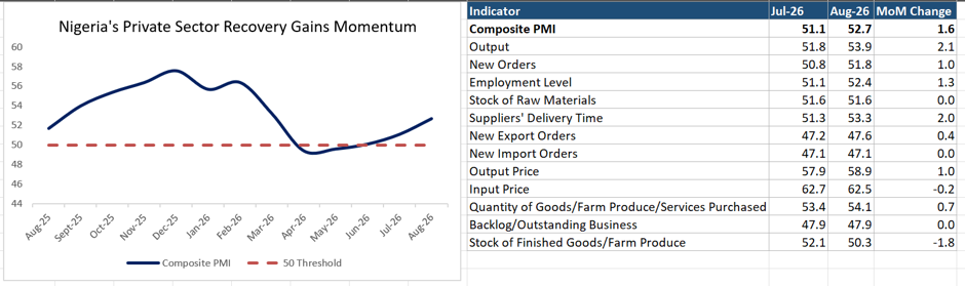
Nigeria’s private-sector activity strengthened further in August, with the Composite Purchasing Managers’ Index (PMI) rising to 52.7 from 51.1 in July, a third consecutive month of expansion. The strength was not confined to the headline: Output rose to 53.9 from 51.8, New Orders climbed to 51.8 from 50.8, and Employment improved to 52.4 from 51.1. Taken together, this suggests the recovery is moving beyond resilience and into genuine expansion. The timing is also notable, coming just days after the NBS reported that Nigeria’s real GDP grew 4.43% year-on-year in Q2 2026, up from 3.89% in Q1, with stronger contributions from both the oil and non-oil sectors. The August PMI therefore offers an early signal that the pickup in economic activity seen in the second quarter has carried into the third.
Source: CBN, SPH Equities Trading Desk
Looking at the trajectory, the Composite PMI fell from 57.6 in December 2025 to a trough of 49.4 in April 2026, before recovering to 49.6 in May, 50.1 in June, 51.1 in July and 52.7 in August. The economy has therefore moved decisively away from the contraction recorded in April, but the August reading is still well below the levels recorded toward the end of 2025. This is a recovery, not yet a return to the previous pace of expansion.
The Recovery Is Becoming More Broad-Based
Source: CBN, SPH Equities Trading Desk
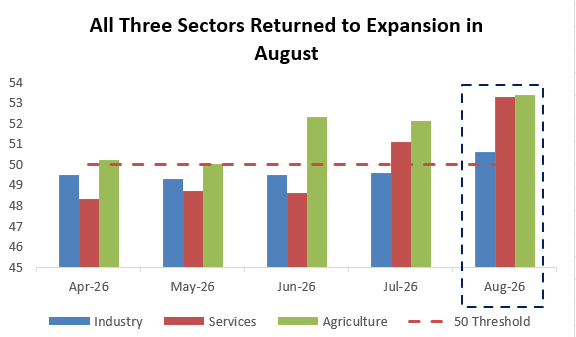
The most significant change in August is that all three sectors are now in expansion. Industry moved above the 50-point threshold for the first time since March, rising to 50.6 from 49.6 in July. Services strengthened to 53.3 from 51.1, while Agriculture increased to 53.4 from 52.1. This marks a genuine improvement in the composition of growth: in June, only Agriculture was expanding; by July, Services had returned to growth while Industry remained below 50. August is the first month in this recovery where all three sectors are simultaneously above the threshold.
Source: CBN, SPH Equities Trading Desk
Beneath the surface, Sectoral Momentum Remains Uneven
Look beneath the surface, however, and the picture is more nuanced: the recovery has broadened at the sector level, but not yet across individual subsectors. Services is currently providing the strongest non-agricultural support, with its PMI rising to 53.3 from 51.1. Business Activity increased to 54.1 from 52.1, New Orders to 52.8 from 50.9, and Employment to 53.3 from 51.4. Nine of the sector’s 11 subsectors expanded, led by Finance & Insurance at 55.8, Information & Communication at 54.3, and Real Estate at 55.2. Trade, however, moderated slightly to 50.9 from 51.3.
While the services recovery is supportive for financial activity, the bigger test is whether the improvement reaches the man on the street. Industrial activity has a stronger multiplier effect across the economy because higher production feeds through supply chains into employment, disposable income, household spending and savings, and ultimately living standards. This is why the industrial sector remains critical to determining whether the current recovery is simply a pickup in economic activity or the beginning of a broader improvement that households can actually feel.
What Happened to the Demand Side ?
The Composite New Orders Index rose to 51.8 from 50.8, while Output increased to 53.9 from 51.8 and Employment rose to 52.4 from 51.1. The progression from June is particularly encouraging. In June, Output and Employment were already above 50, at 50.5 and 51.0, respectively, but New Orders remained in contraction at 49.0. July brought New Orders back above 50, and August has now taken it further into expansion. That matters because New Orders provide an important forward-looking signal of demand. When orders strengthen, they create the conditions for higher production, capacity utilization, revenue and, ultimately, corporate earnings. The August numbers therefore point to a stronger quality of recovery than the headline PMI alone suggests. However, the improvement remains largely domestic. New Export Orders stayed below 50 at 47.6, while New Import Orders stood at 47.1, suggesting that Nigeria’s recovery is being driven more by domestic demand than by a broad recovery in external trade.
Industry Has Returned, But Has It Really Recovered?
Industry finally moved into expansion at 50.6 from 49.6, ending the contraction that had persisted since April. Output also recovered to 51.4 from 49.2, while Employment remained in expansion at 50.7. Supplier delivery times improved sharply to 53.3 from 51.3, pointing to better operational conditions.
On the surface, this looks like an industrial recovery, But the underlying numbers tell a more cautious story. Industrial New Orders remained in contraction at 49.0, while raw-material inventories were also below 50 at 49.4. And only five of the 16 industrial subsectors expanded, while 11 contracted. Industry has crossed the 50-point line, but demand has not yet fully followed. The improvement in output appears to have been supported by better production conditions, employment and supplier performance rather than a broad-based increase in industrial orders.
The subsector data reinforces the caution. Oil Refining led the industrial subsectors with a PMI of 66.5, while Mining and Quarrying also expanded at 59.5. At the other end, several manufacturing-related subsectors remained weak, showing that the industrial recovery is still uneven.
For the NGX, this distinction matters because, the move above 50 is a positive signal for industrial names, but we would want to see industrial New Orders move decisively above 50 before treating the August number as confirmation of a broad manufacturing earnings recovery.
Agriculture Remains the Most Consistent Part of the Recovery
Agriculture continues to provide the most reliable support to the economy. Its PMI rose to 53.4 from 52.1, extending its expansion streak to 25 consecutive months, with all five agricultural subsectors recording growth. More importantly, General Farming Activities increased to 56.5 from 54.4, New Orders rose to 53.2 from 52.8, and Employment improved to 52.7 from 50.9. This is a healthier agricultural signal than simply saying the sector remains above 50. Activity, orders and employment are moving together.
But there is another side to the story. Food inflation reached 20.31% in July, up from 17.52% in June, even as headline inflation moderated to 15.43% from 15.91%.
This divergence matters because agricultural expansion has not yet translated into a corresponding easing in food prices. For households, therefore, the recovery in economic activity does not necessarily mean a recovery in real purchasing power. That remains an important constraint on consumer-facing businesses.
What Is Happening to Costs?
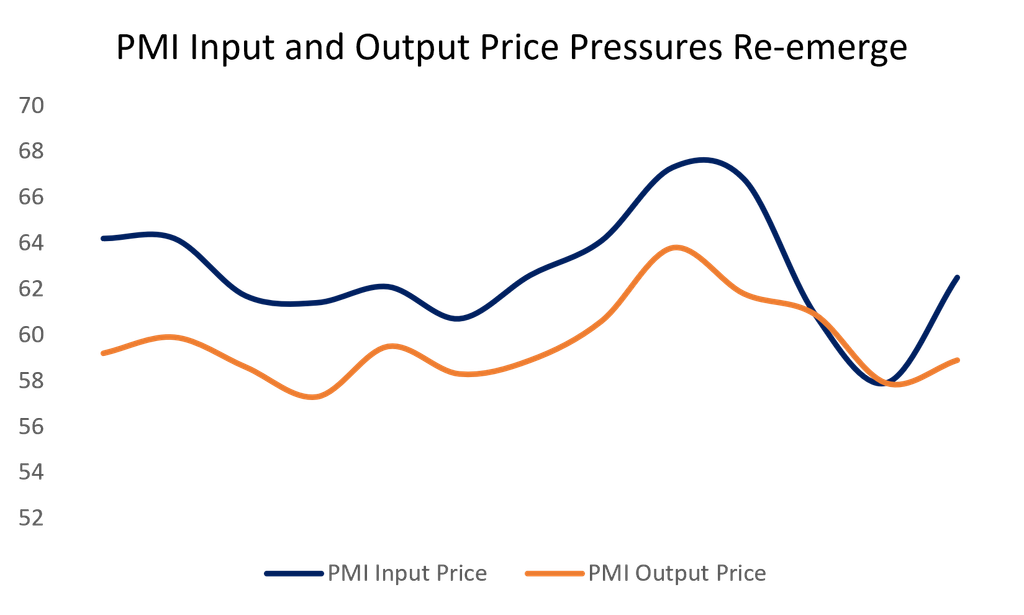
The cost story is more complicated than the headline suggests. The August PMI price indices provide another interesting signal. The Composite Input Price Index edged down to 62.5 from 62.7, while the Output Price Index increased to 58.9 from 57.9.
This is not a renewed input-cost shock. Rather, input-cost pressure remains elevated but broadly stable, while firms are showing somewhat greater ability to increase selling prices.
That is relevant for margins. The fact that output prices are rising while input prices are broadly unchanged is potentially supportive for companies’ ability to protect or rebuild margins, provided demand remains strong enough to absorb higher selling prices.
Source: CBN, SPH Equities Trading Desk
We would, however, avoid overstating the inflation signal. PMI price indices are diffusion indices rather than measures of the percentage change in consumer prices. The more useful interpretation is that business cost pressures remain high, but they are no longer accelerating at the same pace as earlier in the year. This sits alongside a broader disinflation story, but with an important caveat: headline inflation has fallen, while food inflation has moved higher. The distinction between the two is increasingly important for businesses exposed to household consumption.
What Does This Mean for the NGX?
For equities, we do not think the August PMI supports a blanket bullish position. Set alongside Nigeria’s recent FTSE Frontier Market reclassification, it instead builds the case for selective positioning. The clearest positive signal is in financials and services. Finance & Insurance rose to 55.8, Information & Communication to 54.3, and Real Estate to 55.2. If this improvement in business activity persists, it should support transaction volumes, fee income and, eventually, credit demand for banks. The constraint remains the cost of funding and the still-tight monetary environment.
The signal for industrial stocks is improving, but it is not yet conclusive. Industry has crossed 50 and output has recovered to 51.4, which is encouraging. However, New Orders remain at 49.0. For cement, construction and other industrial names, the next confirmation should therefore come from a sustained recovery in orders rather than another isolated improvement in the headline Industry PMI.
For consumer goods companies, the picture is more mixed. Services and Trade are expanding, and Agriculture remains strong, but food inflation at 20.31% continues to put pressure on household purchasing power. In other words, nominal activity can improve without producing a comparable increase in real consumer demand.
The agricultural complex presents a different opportunity. Twenty-five consecutive months of expansion, stronger farming activity and improving employment point to continued resilience in the sector. The key question is whether this strength eventually feeds through into greater food supply and lower food-price pressure.
The Bigger Macro Picture
The August PMI is consistent with the broader improvement in Nigeria’s macroeconomic picture. Q2 GDP growth accelerated to 4.43%, while recent assessments have also pointed to stronger external buffers and improved macroeconomic resilience. Moody’s, for example, recently revised Nigeria’s sovereign outlook to positive from stable, citing stronger external resilience and better-than-expected economic growth.
But stability should not be confused with a complete recovery.
The harder question is whether this momentum can become self-sustaining.
That will depend on whether industrial New Orders move above 50, whether stronger activity translates into higher capacity utilization, whether food inflation begins to moderate, and whether businesses can maintain pricing power without weakening demand.
For monetary policy, the picture is also becoming more balanced. The CBN retained the MPR at 26.5% at its July meeting, citing heightened global uncertainties and risks to energy prices and inflation. The August PMI provides stronger evidence of economic activity, but the combination of elevated food inflation and external risks still argues for caution rather than an aggressive easing cycle.
Investment Takeaway
August’s PMI is a better report than July because the recovery has become stronger and, at the sector level, broader. The Composite PMI rose to 52.7, all three major sectors moved above 50, New Orders strengthened to 51.8, Output rose to 53.9, and Employment increased to 52.4.
But the most important message is not that Nigeria is simply growing again. It is that the quality of the recovery is improving, but the industrial transmission mechanism is still incomplete.
Services and Agriculture are already providing meaningful support. Industry has returned to expansion, but industrial demand remains below the threshold. For the NGX, this favours a selective approach: financials and service-oriented businesses have a clearer near-term macro tailwind, while industrial names are moving from a recovery story toward confirmation, but they are not there yet.
The next PMI reports will therefore be less about whether the Composite PMI stays above 50. The more important question is whether industrial orders finally turn positive and whether stronger economic activity begins to translate into broader corporate earnings growth and affect the standard of living of the man on the street.
Kindly find the Report Below
Thanks for reading.