
Discussion Point:
Nigeria does not need to mine copper for copper to matter; it only needs to execute the infrastructure
cycle copper is signaling.
For decades, the US dollar has anchored the global financial system, not because it is perfect, but because it is
liquid, trusted, and supported by deep capital markets. That role is not collapsing, but it is no longer taken for
granted. In recent years, the growing use of financial sanctions, rising geopolitical fragmentation, mounting
fiscal strain, and questions around institutional independence have pushed investors and policymakers to
reassess concentration risk in the system. However, this shift is not sudden or chaotic. It is deliberate, forward
looking, and driven by preparation rather than panic
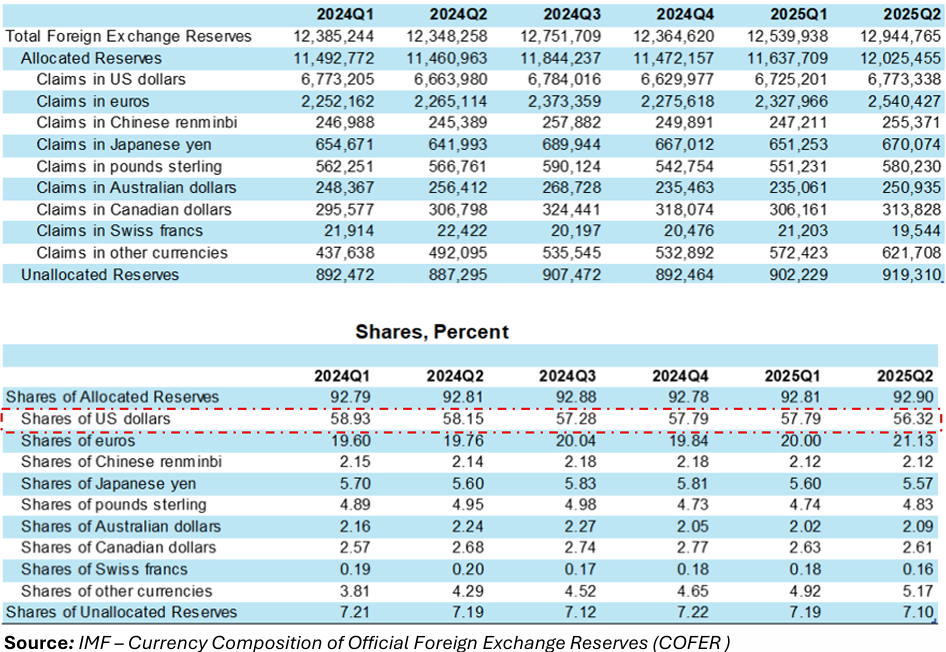
IMF COFER report and data shows that the dollar’s share of global foreign exchange reserves has declined over
the long term, falling from about 72 percent in the early 2000s to roughly 57 percent today. The table above
captures the most recent phase of that adjustment, with the dollar’s share easing further between 2024 and
mid-2025. This is not evidence of sudden de-dollarisation, but of slow, structural diversification that has played
out over decades. Reserve allocations have gradually broadened beyond the dollar, reflecting a desire to
reduce concentration risk rather than abandon the existing system. The message is subtle but important: the
world is not abandoning the dollar; it is reducing reliance on any single anchor.
When Trust Is Tested, Capital Looks for Safety
History shows that when trust in monetary and financial arrangements is tested, capital tends to move toward
assets perceived to sit outside the fiat system. This pattern has repeated across major episodes of stress from
the Global Financial Crisis to the Eurozone sovereign debt crisis, and again following the post-2020 inflation
surge and geopolitical shocks. In the current cycle, gold has been the most visible beneficiary of this behaviour.
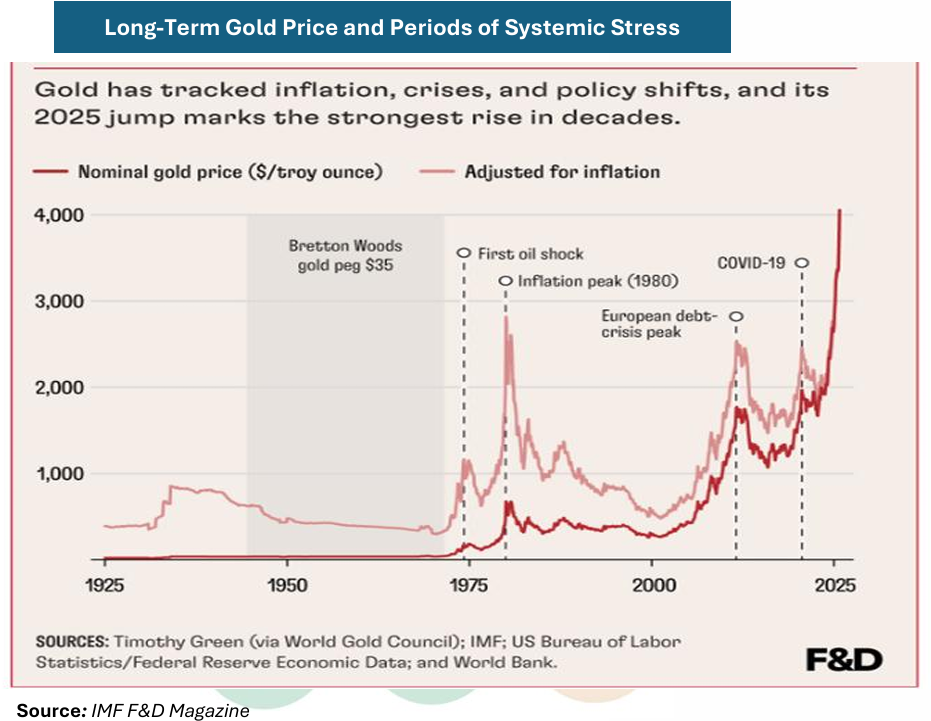
Gold prices have risen sharply as investors seek protection rather than growth. Gold acts as insurance when
confidence in monetary systems weakens. But markets do not stop at insurance.
After Protection Comes Rebuilding
Markets don’t stop at defence. Once fear is priced in, capital moves on. It rotates toward assets tied to
rebuilding, especially where policy direction and fiscal commitment are clear. We’ve seen this before. After the
Global Financial Crisis, investors rushed into safe assets, then rotated into industrial commodities and
infrastructure during the recovery. The same pattern followed the Eurozone debt crisis.
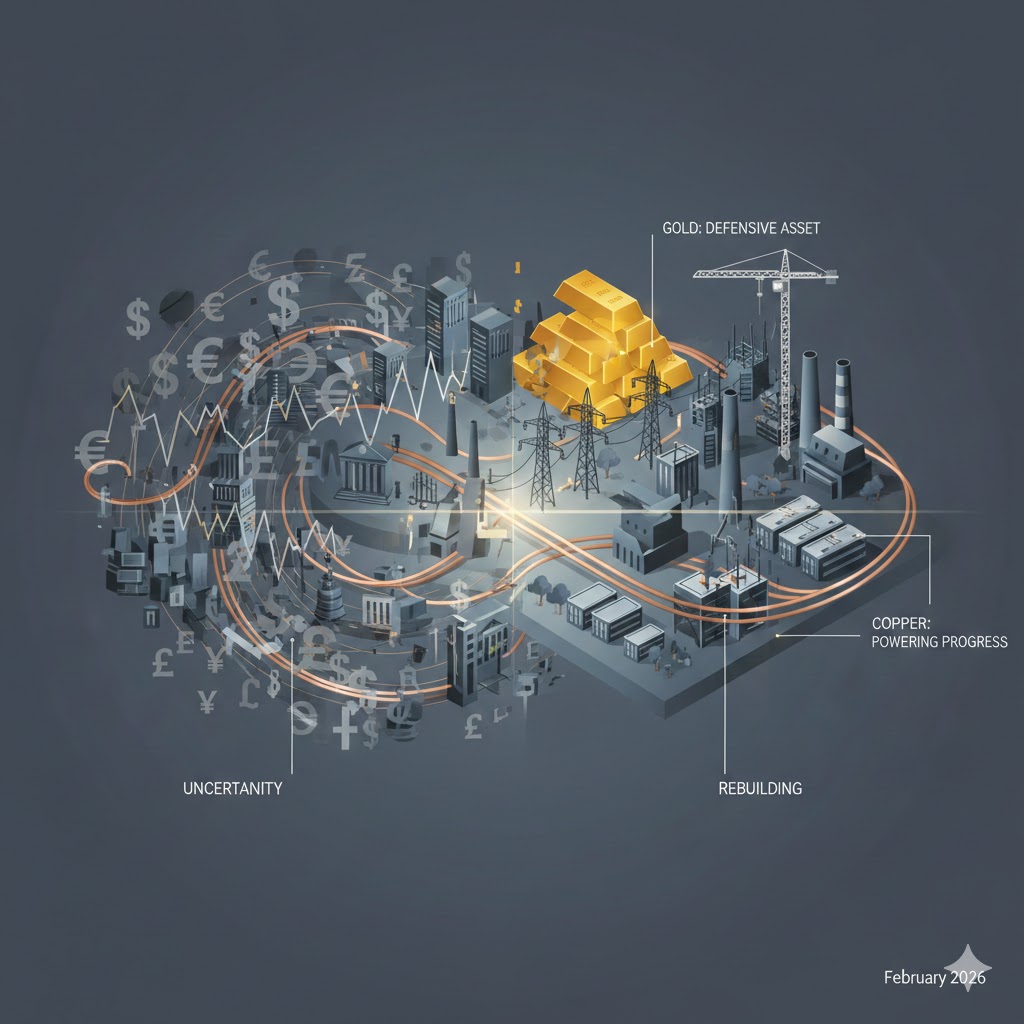
That shift is happening again. Gold has done its job. It absorbed the fear. Now attention is turning to what
governments and companies are actually building.
This is where copper enters the conversation. Copper is fundamentally different from gold. It is not held for
comfort. It is used to make things work. Power grids, electrification, transport systems, data centres, none of
these exist without copper. Its value is practical, not symbolic. As the International Energy Agency has
repeatedly stressed, there is no large-scale energy transition without materially higher copper use.
Why Copper Has Started Behaving Differently
Since 2020, copper has broken from its old playbook. For much of the past two decades, prices tracked the
global growth cycle, rising during expansions and falling during slowdowns. That pattern changed after the
pandemic. Copper prices surged from 2020 and, more importantly, refused to fall back to pre-pandemic levels
even as central banks delivered the most aggressive monetary tightening in decades between 2022 and 2024.
Historically, such tightening would have crushed industrial metals. This time, it didn’t.
Other Current Accounts Components in Q3 2025
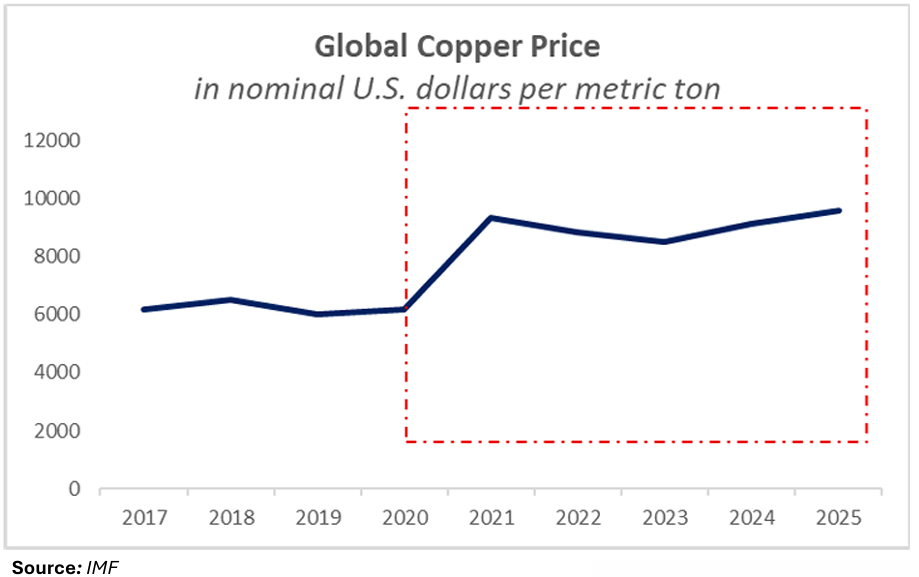
The persistence of high prices tells a clear story: copper demand is no longer driven mainly by short-term growth
cycles. It reflects structural investment. The International Energy Agency and the World Bank both point to the
same drivers which are electrification, grid expansion, renewable energy, electric vehicles, data centres, and
large scale infrastructure upgrades, all of which require far more copper than legacy systems.
Crucially, much of this demand is locked into policy frameworks and long-dated capital programmes, from grid
modernization plans to clean energy targets and strategic industrial policies. That makes copper demand less
sensitive to near-term slowdowns. In simple terms, copper is being repriced for how it is used. The market is no
longer treating it as a cyclical signal, but as a core input into the physical systems being built for the next phase
of the global economy.
So what Changed After 2020
Copper’s post-2020 rally did not come from a single trigger. Several forces shifted at the same time.
First, monetary conditions flipped. After the COVID-19 shock, central banks injected extraordinary liquidity into
the global system. The US Federal Reserve expanded its balance sheet aggressively, while real interest rates
across advanced economies turned deeply negative. Federal Reserve and IMF data show that real yields on US
Treasuries remained below zero for much of 2020–2022. In such environments, capital historically moves toward
real assets. Gold responded first, rising as a store of value. Copper followed, not as a fear hedge, but as a
beneficiary of how that liquidity was ultimately deployed into construction, power systems, and industrial
capacity. This gold first, copper-next sequence mirrors the post-2008 cycle, but on a much larger scale.
Second, fiscal policy returned in force. Unlike the decade after the Global Financial Crisis, the post-2020
recovery was not led by central banks alone. Governments stepped back into the economy. In the United States,
the Infrastructure Investment and Jobs Act and the Inflation Reduction Act explicitly targeted power grids, clean
energy, EV supply chains, and domestic manufacturing. In Europe, the NextGenerationEU programme prioritised
energy security and electrification. China accelerated grid expansion, renewables, and strategic industrial
capacity.
These programmes are copper-intensive by design. The International Energy Agency estimates that clean energy
technologies require materially more copper than fossil-fuel systems, embedding copper demand directly into
fiscal execution rather than discretionary spending.
Third, the global business cycle changed shape. Post-2020 growth has been less consumption-led and more
capital-expenditure-driven. Supply-chain fragility, energy security concerns, digitalisation, and geopolitical
fragmentation pushed economies toward rebuilding physical systems such as power transmission, data
centres, transport networks, and industrial redundancy. The IMF and World Bank have both documented this
shift toward investment-heavy growth. Copper sits at the centre of this transition because it is a core input into
electrification and infrastructure. These projects are multi-year, policy-backed, and far less sensitive to short
term sentiment. That structural shift explains why copper broke out after 2020 and did not return to pre
pandemic ranges.
Copper as a Productive Asset, Not Just a Commodity
IMF research using Chile as a case study helps clarify copper’s evolving role. In earlier cycles, commodity booms
often destabilised economies. During the 1970s and early 2000s, sharp rises in copper prices were frequently
associated with overheating, currency appreciation, and boom-bust fiscal cycles. The IMF has shown how weak
fiscal rules and rigid exchange-rate regimes amplified volatility, turning commodity windfalls into macro risk.
More recent experience tells a different story. IMF analysis shows that with credible fiscal frameworks,
transparent revenue management, and flexible exchange rates, copper price upswings can support income,
external balances, and investment without destabilising the economy. Chile’s use of structural balance rules
and sovereign wealth buffers is often cited as evidence that commodity revenues can be absorbed productively
rather than destructively.
For investors, the implication is clear. Copper now rewards structure and execution, not chaos. Demand today is
tied less to speculative excess and more to productive capacity: grids, electrification, industrial systems, and
long-dated infrastructure investment. In that sense, copper behaves less like a boom-bust commodity and more
like a macro transmission asset: one that reflects how effectively policy intent is converted into physical
investment.
What This Means for Nigerian Equities
This discussion is not centred on Nigeria’s copper demand or import volumes, but on price signals and
investment transmission.
Nigeria is not a copper producer par se, so the relevance of rising copper demand is not about mining exposure.
The transmission runs through how copper is used globally. Copper demand is rising because the global
economy is rebuilding power systems, transmission networks, data infrastructure, and industrial capacity.
These projects are capital-intensive, multi-year, and policy-driven. When this type of investment accelerates
globally, it shows up locally through execution, not extraction. Over time, global investment cycles tend to work
their way through to local economies. In that sense, copper functions as a signal of whether the world is building
or stalling, much like how global semiconductor cycles matter for markets that do not produce chips
themselves.
For Nigerian equities, this matters in three clear ways. First, power generation and energy infrastructure benefit
from sustained grid investment. Companies such as Transcorp Power and Geregu Power are positioned to gain
as transmission upgrades reduce technical bottlenecks, improve dispatch reliability, and support more
predictable cash flows. Grid stability turns installed capacity into usable revenue.
Second, construction and engineering firms benefit from longer project pipelines. Companies like Julius Berger
Nigeria typically see stronger order books when governments and utilities commit to transmission lines,
substations, and large-scale energy projects. These are not one-off contracts, but rolling programmes that
improve asset utilisation and earnings visibility.
Third, cement producers gain from the civil works that accompany electrification and industrial expansion.
Dangote Cement, WAPCO and BUA Cement benefit indirectly as grid expansion, power projects, and industrial
facilities require foundations, roads, and supporting infrastructure. Cement demand in this context is structural
rather than cyclical.
At the same time, higher global copper prices act as a filter within the equity market. Companies with heavy
reliance on imported inputs and weak pricing power face margin pressure, particularly where FX exposure is
unhedged. This mirrors the cocoa example in reverse: rising input costs benefit some players but compress
margins for others.
The implication is that copper’s signal for Nigerian equities is selective, not broad-based. It favours companies
exposed to infrastructure execution, power stability, and construction activity, rather than firms dependent on
cheap imports or short-term consumption.
Gold and Copper Are Sending Different Messages
Gold and copper are responding to the same macro shift, but at different points in the cycle. Gold typically
moves first when confidence in monetary systems is questioned, as seen during the Global Financial Crisis, the
Eurozone debt crisis, and again after the post-2020 inflation surge. Its recent strength reflects demand for
protection and value preservation.
Copper’s signal is different. According to the International Energy Agency and World Bank, copper demand rises
with investment in power grids, renewable energy, electric vehicles, and infrastructure. It is consumed, not
stored. In simple terms, gold protects value when trust is tested, while copper reflects commitment to rebuilding
and productivity.
The Takeaway for Investors
The global system is not experiencing a collapse of the dollar. Trust is being spread more carefully, and investors
are paying closer attention to where resilience comes from. That shift has already shown up in markets. Gold has
done its job as a safe place to hide when uncertainty was high, and prices it’s now reflects fear. Copper, on the
other hand, is reacting to what comes next which is rebuilding, electrification, and long-term investment.
So the real question for investors is where to go from here. Buying gold after it has already break All time high
which carries its own risks. Developed markets have already moved higher, leaving less room for upside
compared with markets that are still adjusting. This is why attention is slowly turning back to emerging markets,
where valuations are lower and returns can still surprise on the upside.
In that context, markets like Nigerian equities deserve a closer look. Last year, Nigerian stocks have delivered
strong returns, even in dollar terms, driven by domestic reforms and a market repricing rather than global
liquidity alone. For equity investors, the opportunity is not about chasing commodities themselves, but about
positioning in markets and companies that stand to benefit from the next phase of global investment. Copper is
not just reflecting today’s economy, it is pointing to where growth and capital are heading next.
Kindly find the Report Below
Thanks for reading.