


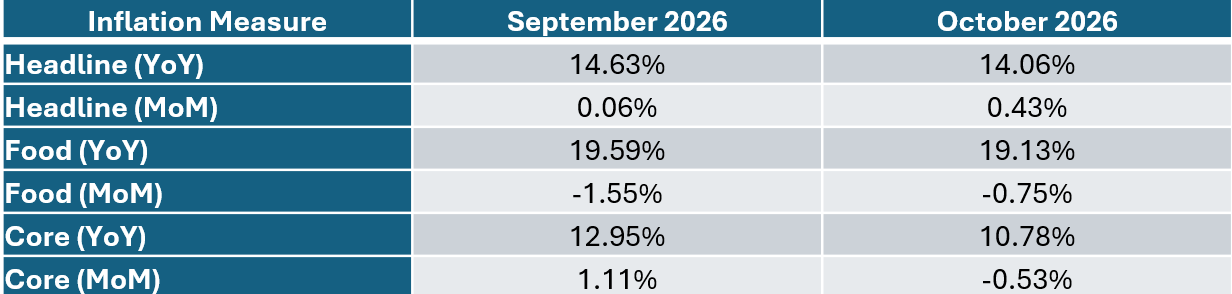
Nigeria’s headline inflation rate eased to 14.06% in October 2026 from 14.63% in September, extending the disinflation trend. However, the moderation in annual inflation masks a slight pickup in monthly price momentum, with headline inflation rising to 0.43% from 0.06% in September. This suggests that while the pace of price increases has slowed compared with last year, underlying cost pressures have not fully disappeared.
Source: NBS, SPH Equities Trading Desk
Disinflation Continues, but the monthly picture is less Comfortable
The October report presents a mixed picture. Headline inflation declined by 0.57 percentage points year-on-year, while the monthly rate accelerated by 0.37 percentage points. In other words, the average price level continued to increase during October, but at a slower pace than the corresponding period last year. The Consumer Price Index also increased to 147.0 from 146.4 in September.
The improvement in core inflation was more pronounced. Year-on-year core inflation declined to 10.78% from 12.95%, while the monthly index recorded a 0.53% decline, compared with a 1.11% increase in September. This suggests that price pressures outside farm produce and energy have eased considerably. However, the acceleration in headline monthly inflation shows that the improvement is not yet broad enough to assume that price stability has been fully restored.
Food remains the most important pressure point for households. Food inflation eased to 19.13% year-on-year from 19.59%, but the monthly rate remained negative at -0.75%, compared with -1.55% in September. This means food prices declined during the month, but the pace of decline was weaker than in September. Food and Non-Alcoholic Beverages also remained the largest contributor to headline inflation, accounting for 5.63 percentage points of the year-on-year rate.
In our view, the Cordros Jollof Index offers a useful way to interpret this pressure from the household perspective. By tracking the cost of a fixed basket of ingredients required to prepare jollof rice, including rice, chicken, tomatoes, peppers, vegetable oil and cooking gas, it captures how food and energy costs combine to affect household affordability. Its inaugural June reading highlighted how higher protein, vegetable and energy costs can keep the cost of a household meal elevated, even when some individual food items become cheaper. This is particularly relevant because a decline in the inflation rate does not necessarily translate into an immediate improvement in household purchasing power.
The divergence across locations also deserves attention. Lagos recorded the highest year-on-year food inflation at 31.43%, despite a 5.93% month-on-month decline. This illustrates how a monthly fall in prices can coexist with a significantly higher price level than a year earlier. It also reinforces the uneven nature of food price movements across the country.
Implications for Equities
For consumer-facing companies, the moderation in inflation is a positive development, but the benefits to earnings may take time to materialise. Lower inflation should gradually ease pressure on household budgets and improve the potential for volume recovery. However, with food inflation still at 19.13% year-on-year, purchasing power remains constrained, particularly for lower-income consumers. Companies in the consumer goods sector will therefore continue to face a difficult balance between passing on input costs and protecting sales volumes.
The decline in core inflation is also encouraging for businesses exposed to non-food operating costs. However, the improvement in the headline figure should not be interpreted as an immediate reduction in production costs. Companies with significant exposure to food inputs, energy, logistics and imported raw materials will remain sensitive to the direction of these costs. The ability to manage costs, maintain pricing discipline and protect margins will remain important differentiators across the sector.
From a monetary policy perspective, the moderation in year-on-year headline and core inflation provides some support for a less restrictive policy stance over time. Nevertheless, the acceleration in monthly headline inflation and the persistence of food price pressures suggest that the Central Bank will need to remain cautious. The direction of monthly inflation, rather than the year-on-year figure alone, will be important in assessing whether disinflation is becoming more sustainable.
Overall, October’s inflation report is encouraging, but the improvement remains uneven. We will be watching the direction of monthly food prices, energy costs and household purchasing power to determine whether the current disinflation trend can translate into a more meaningful recovery in consumption and corporate earnings.
Kindly find the Report Below
Thanks for reading.