


The Monetary Policy Committee’s decision to cut the Monetary Policy Rate (MPR) by 350bps, from 26.50% to 23.00%, brings the policy rate closer to where short-term market rates have already been trading across Treasury bills, OMO bills and other money-market instruments. In our understanding, the CBN’s motive is to reduce the gap between the policy rate and prevailing market rates, allowing the policy rate to better reflect actual market conditions.
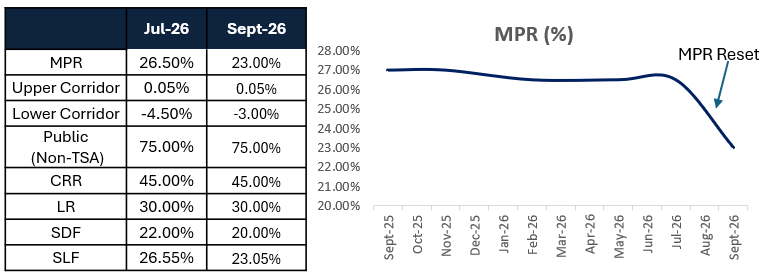
Source: CBN, SPH Equities Trading Desk
However, the decision also shows that the CBN is easing more through the price of money than through changes in reserve requirements. The CRR remains at 45% and the Liquidity Ratio at 30%, meaning the structural liquidity requirements on banks have not changed. This suggests that the CBN is easing through the price of money, while remaining cautious about materially changing the quantity of liquidity available within the banking system. The adjustment to the Standing Facilities Corridor reinforces this direction. The SDF was reduced from 22% to 20%, reducing the incentive for banks to leave excess liquidity with the CBN. At the same time, the SLF was also reduced, lowering the cost at which banks can access CBN liquidity. Taken together, these adjustments should improve the transmission of the lower MPR to the money market.
On inflation leg, the August inflation report showed headline inflation at 15.39%, monthly inflation at 0.71% and core inflation at 13.29%, with core inflation turning negative month-on-month. The decision therefore comes against a backdrop of improving disinflation, giving the CBN more room to begin reducing the restrictiveness of monetary policy.
What Does This Mean for Equities?
This could be a supportive rally catalyst the equities market is waiting for after the FTSE reclassification and Dangote Refinery IPO announce. However, immediate transmission should come through lower yields and the cost of capital. As policy rates decline and market yields adjust, the discount rate applied to future corporate cash flows should also fall, improving the valuation environment for equities. Lower fixed-income yields can also gradually increase the relative attractiveness of equities for investors seeking returns beyond government securities.
The second channel is corporate earnings. Lower borrowing costs should be supportive for companies that rely on bank financing, particularly businesses with relatively high leverage or significant working-capital requirements. A lower cost of funding can reduce finance costs and provide some support to earnings, while improved credit conditions could also support investment and economic activity.
The main caveat is the external rate environment. While the CBN is cutting rates, the Federal Reserve recently raised its target range to 3.75%-4.00%, meaning global dollar funding conditions remain relatively tight. This matters for institutions with dollar-denominated funding, including DFI facilities that are raised in dollars and on-lent in naira.
Kindly find the Report Below
Thanks for reading.