
Summary:
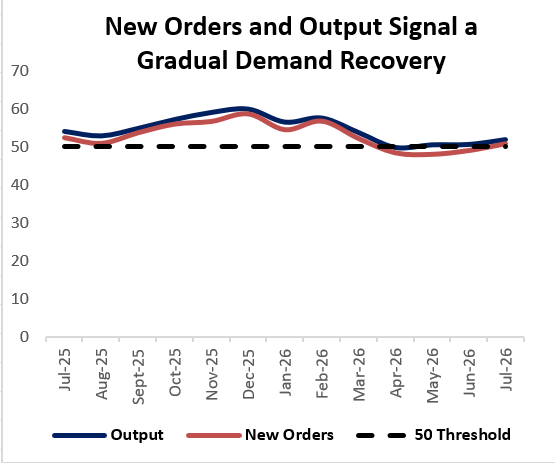
Nigeria’s private-sector activity strengthened in July, with the Composite Purchasing Managers’ Index (PMI) rising to 51.1 from 50.1 in June, marking a second consecutive month of expansion. More importantly, the improvement was underpinned by stronger demand, as New Orders rose to 50.8 from 49.0 and Output increased to 51.8 from 50.5.
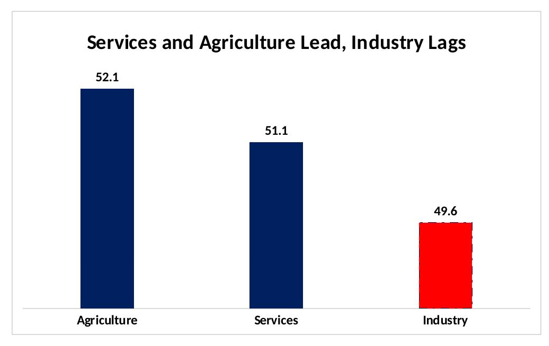
The recovery, however, remains uneven. Services returned to expansion at 51.1 from 49.4, and Agriculture held steady at 52.1. Industry improved only marginally, to 49.6 from 49.5, and remains below the 50-point threshold. In short, July shows an economy that is recovering, with demand beginning to strengthen, but one that has not yet delivered a full recovery on the productive and industrial side.
Where We’re Coming From
The July reading is best understood against its recent trajectory. Nigeria’s Composite PMI fell below the 50-point threshold in April 2026, declining to 49.4, before improving slightly to 49.6 in May. It returned to expansion at 50.1 in June and strengthened further to 51.1 in July. What matters is what changed between June and July. June’s recovery was carried largely by Agriculture, with both Services and Industry still in contraction. By July, Services had returned to expansion and New Orders had moved back above 50 — a broader-based improvement than June’s, even though Industry has yet to participate.
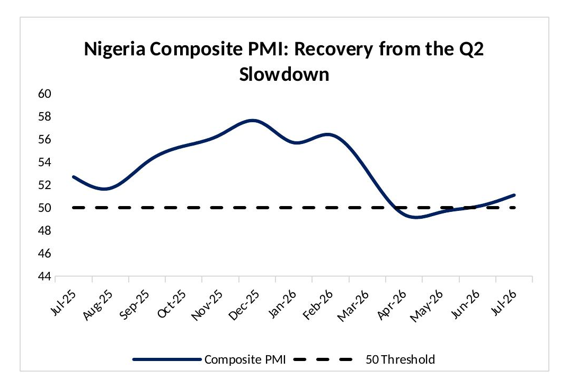
Source: CBN, SPH Equities Trading Desk
The chart tells a recovery story, but one that has not yet returned to the strength seen at the end of 2025. July is another step in the recovery, not a return to a strong growth cycle.
What’s Driving the Headline
Services was the biggest source of improvement, rising to 51.1 in July from 49.4 in June and ending three consecutive months of contraction. The rebound matters because the recovery no longer rests on Agriculture alone. Agriculture remained the strongest performer, holding at 52.1, unchanged from June and continuing to provide a stable base for overall activity. Industry, meanwhile, edged up to 49.6 from 49.5: still in contraction, though the pace of contraction has slowed. The breadth of activity also improved: of the 32 subsectors surveyed, 20 recorded expansion in July against 12 in contraction, a broader recovery than June’s, even if the divergence across sectors remains wide.
Source: CBN, SPH Equities Trading Desk
Beneath the Headline: Demand Is Finally Improving
The most encouraging development in the July report is the movement in New Orders. The Composite New Orders Index rose to 50.8 from 49.0 in June, moving back into expansion after a month below the 50-point threshold. Output rose to 51.8 from 50.5, and Employment edged up to 51.1 from 51.0.
This matters because New Orders is a forward indicator of demand. In June, businesses reported expanding Output and Employment even as New Orders stayed in contraction. It was a gap that raised doubts about whether the recovery could be sustained. July provides a more encouraging signal: demand improved alongside production, although further readings are needed to confirm that the recovery is sustainable.
The sectoral breakdown reinforces this improvement. Services’ New Orders rose to 50.9 from 48.7, while its Business Activity/Output index rose to 52.1 from 49.8, indicating meaningful improvement in both demand and activity. Agriculture also strengthened beneath the headline: although its overall PMI held at 52.1, New Orders rose to 52.8 from 50.7 and General Farming Activities rose to 54.4 from 53.9, suggesting that the sector’s expansion is gaining further support from demand.
Industry tells a different story. Its New Orders improved to 48.9 from 48.1, while Output rose to 49.2 from 48.9. Both indicators nevertheless remained below 50. This is the key reason the overall recovery cannot yet be called broad-based: demand is improving at the Composite level, but that improvement remains concentrated outside Industry.
Source: CBN, SPH Equities Trading Desk
The key development is visible in July: Output improved from 50.5 to 51.8, and New Orders crossed from 49.0 to 50.8, a stronger signal than the headline PMI alone, since it shows that improving activity is now being supported by demand rather than running ahead of it.
Industry Remains the Missing Link
Industry deserves particular attention because it remains the weakest part of the recovery. Its PMI rose only marginally, to 49.6 from 49.5, and the underlying indicators remain soft. Output improved to 49.2 from 48.9, New Orders rose to 48.9 from 48.1, and the Stock of Raw Materials weakened to 48.2 from 49.8; all three remained below the expansion threshold. The message is clear: although orders and production improved modestly, industrial businesses are not yet seeing enough demand to support a sustained increase in production.
The weakness is visible at the subsector level too. Cement recorded a PMI of 45.7, Oil Refining stood at 40.0, and Basic Metal, Iron and Steel remained below 50 at 47.6. Construction also stayed in contraction at 47.7. Electrical and Electronics was the exception, posting a strong 61.6. This is a reminder that the industrial sector’s weakness is not uniform.
That distinction matters for investors. The industrial story is not one of complete contraction; there are genuine pockets of strength. However, the broader sectors tied to manufacturing, construction and capital spending have not yet recovered enough to confirm a wider industrial cycle. This is why Industry remains the missing link between economic stabilization and a broader earnings recovery. The next question is what cost pressures are telling us.
Cost Pressures Are Easing, but Businesses Are Still Paying More
Price pressures moderated in July, although they remained elevated. The Composite Input Price Index eased to 62.7 from 64.3 in June, while the Composite Output Price Index declined to 57.8 from 60.9. Both readings remained above 50, indicating that input costs and selling prices continued to rise, but at slower rates. This matters for margins: if input costs remain elevated while selling-price increases moderate more quickly, businesses may face continued pressure on profitability.
At the sector level, Services’ Input Price Index rose to 62.7 from 61.8, while its Output Price Index eased to 59.2 from 60.0. Agriculture’s Input Price Index moderated to 64.7 from 67.6, and its Output Price Index fell sharply to 54.9 from 62.4, providing evidence that price pressures are easing in parts of the economy even as costs remain elevated overall. On balance, July points to moderating price pressures, although the Services input-cost reading shows that the improvement was not uniform.
What Is Driving the Recovery?
The data suggest that the recovery is still driven mainly by domestic activity. External demand remains weak: Services’ New Export Orders rose only marginally to 48.0 from 47.8, while New Import Orders increased to 47.8 from 46.9; both remained below the 50-point threshold. The recovery is therefore not yet being carried by a strong external-demand cycle. Instead, the rebound in Services and continued strength in Agriculture point to domestic activity as the primary driver, making the sustainability of household and business demand an important factor to watch in the months ahead.
What Does This Mean for the NGX?
For Nigerian equities, the July PMI supports a selective rather than a blanket-bullish view. The strongest near-term signal sits with Services and domestic activity. Finance and Insurance recorded a headline PMI of 51.6, down from 53.0 in June, while its Business Activity strengthened to 56.4 from 55.7, pointing to continued expansion. Information and Communication improved to 51.6 from 51.0, with Business Activity rising to 53.6 from 51.5. For banks, improving business activity is directionally supportive of transaction volumes and fee income, although the transmission to credit demand and earnings will require confirmation from company-level operating data. Industrial and construction-linked equities require more patience. Cement (45.7), Construction (47.7) and Oil Refining (40.0) don’t yet confirm a broad industrial recovery. For names such as Dangote Cement, BUA Cement and Julius Berger, a stronger investment signal will come once industrial New Orders and construction activity move sustainably above 50. For now, these are best viewed as recovery opportunities that still need macro confirmation not evidence that the industrial earnings cycle has already turned.
What We’re Watching Next
The July report improves the outlook, but the next few releases will be important for confirmation on three fronts:
1. New Orders need to stay above 50. The move from 49.0 in June to 50.8 in July is encouraging, but one month doesn’t establish a sustained demand cycle.
2. Industry needs to move from 49.6 into expansion and more specifically, its New Orders (48.9) and Output (49.2, down from 49.5) need to improve. Until then, the recovery stays concentrated in Services and Agriculture.
3. Cost pressures need to keep moderating. Input costs remain elevated, and any renewed pressure could weigh on both household demand and corporate margins.
The next phase of the story is straightforward: July showed the recovery can broaden. The next test is whether it can deepen.
Investment Takeaway
The near-term macro signal is stronger for businesses exposed to Services and domestic activity, while industrial and construction-linked names still need confirmation that stronger demand is translating into production.
The key question is no longer whether Nigeria’s business activity is beginning to recover; July provided further evidence that it is. The bigger question is whether the recovery can move from demand and Services into Industry and, ultimately, into a broader corporate earnings cycle.
Kindly find the Report Below
Thanks for reading.