


The hidden cost of war on Nigeria’s capital market
The Middle East supply shock has produced a narrow windfall and a broad bill. Higher crude prices lifted a small group of earners: the Federation Account, upstream producers and refiners. Households, businesses, borrowers and, increasingly, equity investors are paying for it. Recent sector performance suggests the market may have priced the initial windfall early and is now reassessing its wider costs. The shock is treated here as an amplifier of existing Nigerian inflation, funding and consumption pressures, not as their sole cause.
Key takeaways
- •Gains are narrow. October oil and condensate output was 8.3% below the budget plan, and 95.8% of real GDP is non-oil (Section 1).
- •Households pay first. Food inflation eased only to 19.13% in October, five points above headline. Nigerian Breweries reports lower volume and net revenue in Q3, and consumer companies are spending more to hold sales (Section 2a).
- •Companies protected margins, not sales. The 2026 margin gains rest on pricing and cheaper funding, and the second may not repeat (Sections 2b, 2c).
- •The rate cut has only partly reached borrowers. Secondary and short-dated OMO yields remain around 17% to 18% after the cut to a 23% MPR, and the March 2036 FGN bond yields 16.60% in the secondary market, about 2.5 points above October headline inflation of 14.06% (Section 2c).
- •Investors are now paying. Even our preferred names yield only 4.6% to 8.7% on trailing earnings against 16.60% on a 2036 FGN bond. Since 30 September the All-Share is flat in naira (+0.4%) but down about 1.4% in dollars (Sections 2d, 3).
- •Desk view. Prefer MTN Nigeria, which has the lowest P/E and highest earnings yield of the three resilient names. Prefer Dangote Cement and Seplat on fundamentals but add on weakness, as valuations are full. Neutral on consumer staples. Cautious on banks and on oil names priced on Brent alone (Section 4).
1. As the shock begins, who benefits first?
First-round gains go to whoever sells crude or refined product in dollars. Brent settled at $116.72 on 23 October, 80% above the 2026 budget benchmark of $64.85, and at $95.84 on 13 November, still 48% above it. Brent fell 2.5% in the week to 13 November, dropping to $91.49 on 10 November before recovering as supply risk rose again. Seplat shows how this reaches listed earnings: a realised price of $96.19/bbl and 7% more production lifted 9M 2026 revenue by 27% and adjusted EBITDA by 38%, and cut net debt by 65%.
Domestic refining widens the circle. Petroleum-product exports rose from 46 kb/d in 2023 to 350 kb/d in Q2 2026, while product imports fell from nearly 400 kb/d to below 130 kb/d. A shock that once drained FX through petrol imports now partly earns it.
Exhibit 1. How the shock is distributed
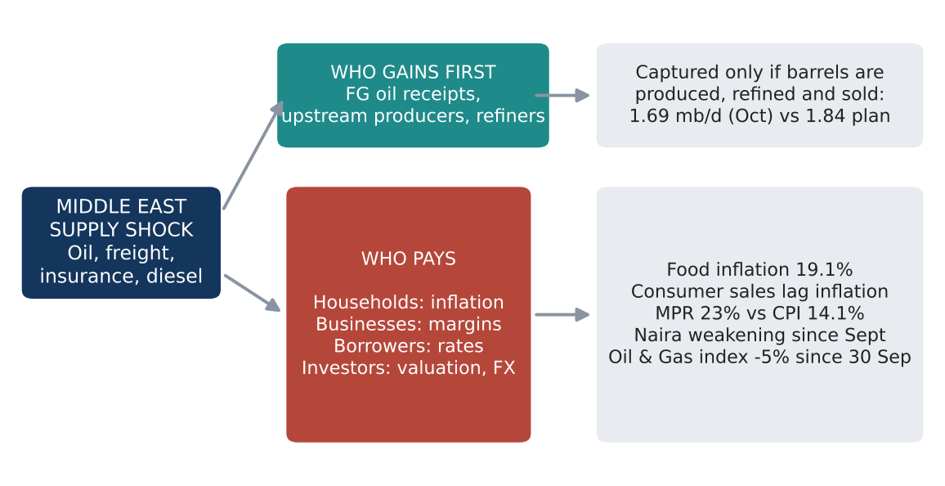
Source: Springhill Capital Equities Desk, using the data in Exhibits 2 to 8.
The limit is volume, not price. Crude and condensate output fell to 1.688 mb/d in October from 1.717 mb/d in September, 8.3% below the 1.84 mb/d budget plan. Crude-only output of about 1.513 mb/d met Nigeria’s 1.5 mb/d OPEC quota for a sixth month, but that quota is not the budget’s capture assumption, and the non-oil economy is 95.8% of real GDP. The windfall is real but lands on a narrow base. The rest of this note follows the cost.
Exhibit 2. Price is well above the benchmark; output is below plan and falling
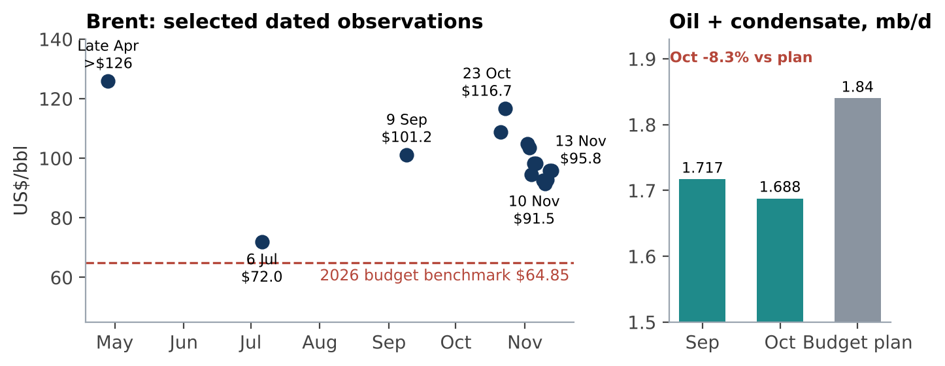
Source: Brent: IEA (late April), Reuters (6 Jul, 9 Sep), ICE front-month futures settlements (21 Oct to 13 Nov; January 2027 contract from 9 Nov). Output: NUPRC (October 2026). Benchmark and plan: 2026 budget via BudgIT. Markers are dated observations, not a continuous series.
2. Who pays for the shock ?
2a. Households pay through inflation
Oil shocks reach households through diesel, transport, freight and imported food, not just the pump price. Headline inflation eased from 15.43% in July to 14.06% in October, and core inflation (excluding farm produce and energy) fell to 10.78%. Food inflation, the largest item in most household budgets, eased only to 19.13% from 19.59%, so the gap to headline widened to 5.07 points.
Company results show the effect. Nestlé Nigeria grew 9M revenue by 10.4% and Nigerian Breweries by 5.4%, both well below food inflation. The evidence now goes beyond inference. Nigerian Breweries’ management reports lower volume and net revenue in the third quarter, with Q3 revenue down 3.0% year on year in naira terms (₦299.0bn against ₦308.2bn). Both companies are also spending more to hold sales: Nestlé’s consumer promotions rose 64% and Nigerian Breweries’ distribution costs 29%. We call this the volume squeeze: households trading down as essentials absorb more of their income. It appears to be one of the broadest channels through which the shock reaches the domestic economy, and it shapes everything that follows.
Exhibit 3. Headline inflation is easing; food inflation is not
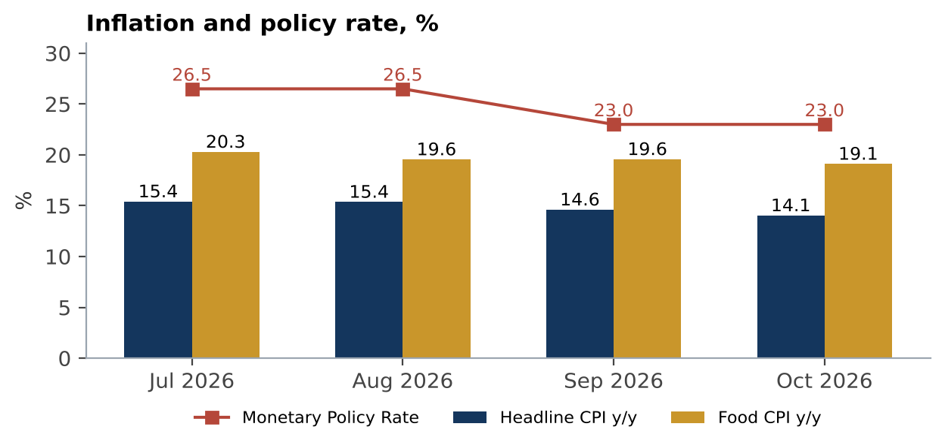
Source: NBS CPI reports (July to October 2026; October released 16 November); CBN MPC communiqués. MPR shown at month end.
2b. Businesses pay through weaker sales and margin pressure
Higher diesel, freight, insurance and, for some producers, energy costs can pressure manufacturing margins. The results suggest that listed consumer companies protected margins even as sales and volumes came under pressure. Nestlé lifted gross margin from 37.0% to 40.2% and Nigerian Breweries from 39.7% to 43.3%, through price increases, cost control and much lower finance costs (Section 2c). Profit after tax rose 43% and 33% respectively, and BUA Foods’ gross margin reached 48.3%.
The evidence suggests the gains came more from pricing, cost control and lower finance costs than from broad-based volume growth, and the market has noticed: the Consumer Goods index is down 1.0% this year to 13 November despite the profit growth. Margin repair built on the volume squeeze lasts only as long as households absorb price rises and funding stays cheap.The contrast is with price-setters that grew revenue faster than inflation. MTN Nigeria grew revenue by 23.6% and lifted its EBITDA margin from 51.4% to 56.9%. Dangote Cement grew revenue by 19.6% on Nigerian volumes up 6.4%, lifted its EBITDA margin to 46.8% and moved from ₦683bn of net debt to ₦51bn of net cash.
Not every input cost has risen. BUA Foods’ revenue fell 19% while gross profit rose 6%, which the company attributes to lower raw-material and energy costs and improved FX stability. Its margin gain is real, but it came with a sharp fall in sales, the clearest sales-side sign of demand pressure among the listed staples reviewed.
Exhibit 4. Margins rose while consumer sales lagged inflation
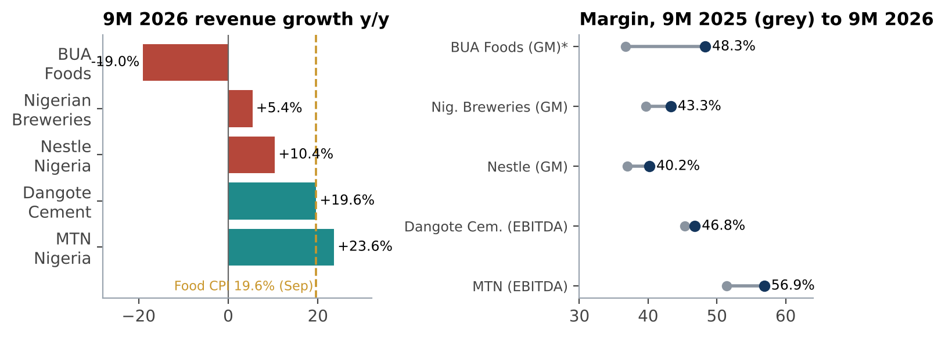
Source: Company 9M 2026 filings via NGX and Nairametrics. GM = gross margin. Nigerian Breweries margin calculated from disclosed gross profit and revenue. BUA Foods 9M 2025 margin from press summary.
2c. Borrowers pay through higher interest rates
In September the CBN cut the MPR by 350bp, from 26.5% to 23%. Market rates have followed only partially, and are now edging up. At the 11 November auction the 91-day and 182-day stop rates held at 15.40% and 15.79%, but the 364-day rate rose 9bp to 15.89%, its first increase since mid-October, after bids of up to 18.50%. The CBN sold ₦3.85tn of OMO bills on 10 November at 15.99% to 17.44%, and system liquidity fell 31% in the week to 13 November. The average secondary T-bill yield was 17.80% on 10 November. Bond yields eased (the FMDA average fell 19bp to 16.18%), and at the 16 November bond auction the DMO sold ₦1.42tn of the ₦2tn offered (bids ₦1.81tn) at marginal rates of 16.89% to 16.99%, keeping new-issue sovereign yields close to 17%; demand concentrated in the May 2033 paper (₦766bn bid for ₦300bn offered).
Government paper now competes with equities. The March 2036 FGN bond yields 16.60% in the secondary market (FMDQ, 12 November), about 2.5 percentage points above October headline inflation (16.60% less 14.06%), without company earnings risk. The September 2036 bond cleared at 17.29% at the October auction. Bank lending is priced off these benchmarks plus a spread, which keeps working-capital and capex funding costly.
This is where the 2026 margin story is exposed. Finance costs fell 73% at Nestlé, 61% at Nigerian Breweries and 25% at MTN Nigeria, a large part of why profits grew faster than revenue. Consensus expectations favour holding the MPR at 23.0% at the 23 to 24 November MPC , allowing the CBN to assess the transmission of September’s 350bp operational reset.
October CPI gives some support to the case for easing, with core inflation down to 10.78%, but food inflation above 19%, a pick-up in monthly headline inflation to 0.43%, energy-price risks, election-related liquidity and the need to preserve FX stability argue for caution.
October CPI gives some support to the case for easing, with core inflation down to 10.78%, but food inflation above 19%, a pick-up in monthly headline inflation to 0.43%, energy-price risks, election-related liquidity and the need to preserve FX stability argue for caution.
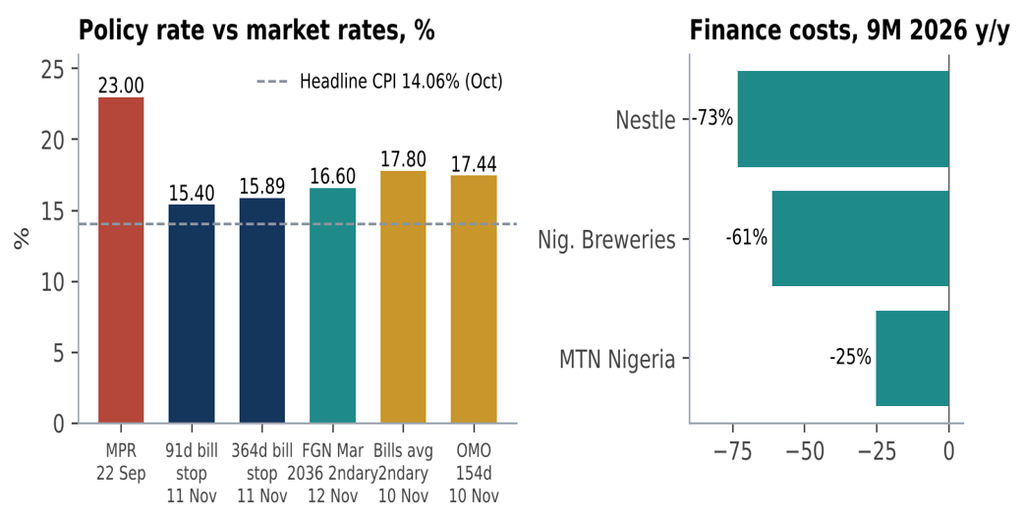
Source: CBN (MPR); NTB and OMO auctions of 10 to 11 Nov and secondary T-bill yield via FMDA and Nairametrics; FMDQ (FGN bond, 12 Nov); NBS; company 9M 2026 filings. Nigerian Breweries shows total finance costs; Nestlé and MTN show net finance costs.
2d. Investors pay through valuation and the currency
Higher rates lower share prices through the discount rate, even when earnings hold. As an illustration, a stock valued as a growing perpetuity with a 22% required return and 12% growth loses about 9% of its value if the required return rises by one point.
The preferred names do not screen as cheap on a simple earnings-yield comparison with government paper. On trailing twelve-month earnings and 13 November prices, MTN Nigeria trades on 11.5x, Dangote Cement on 19.8x and Seplat on 21.6x, earnings yields of 8.7%, 5.1% and 4.6%. The March 2036 FGN bond yields 16.60%. Their earnings yields sit well below this sovereign benchmark, so investors need strong future earnings and dividend growth, orcontinued valuation support, to justify the extra equity risk. The share prices already reflect strong expectations: MTN is up 64% this year, Dangote Cement 141% (including 9.6% in the week to 13 November) and Seplat 180%. MTN has the highest earnings and dividend yields among the three, although both remain below the sovereign benchmark; Dangote Cement and Seplat leave little room for disappointment.
Exhibit 6. Earnings yields on preferred names sit far below the sovereign benchmark yield
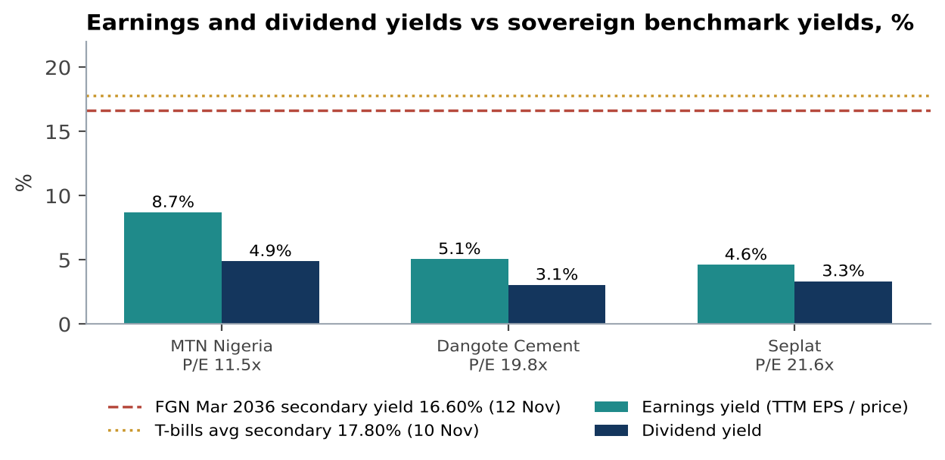
Source: NGX closing prices (13 Nov 2026; 31 Dec 2025 Daily Official List). Trailing EPS = FY2025 EPS − 9M 2025 EPS + 9M 2026 EPS, from company filings. Benchmark: FGN March 2036 secondary yield, FMDQ, 12 Nov 2026. Seplat price is ex-dividend from 13 Nov.
| Company | Price 13 Nov (₦) | YTD price | TTM EPS (₦) | P/E (TTM) | Earnings yield | Dividend yield | Gap to 16.60% |
| MTN Nigeria | 837.00 | +63.8% | 72.90 | 11.5x | 8.7% | 4.9% | −7.9 pts |
| Dangote Cement | 1,469.90 | +141.4% | 74.41 | 19.8x | 5.1% | 3.1% | −11.5 pts |
| Seplat Energy | 16,241.90 | +179.6% | 750.46 | 21.6x | 4.6% | 3.3% | −12.0 pts |
Dividend yield: MTN ₦41.00 (FY2025 final ₦15.00 + 2026 interim ₦26.00); Dangote Cement ₦45.00 (FY2025 final; no 2026 interim); Seplat US$0.40 declared in 2026 to date at ₦1,358.34/US$ (CBN NFEM rate fixed for its Q3 dividend). Bases differ. Seplat YTD is price only, after the 13 Nov ex-dividend adjustment.
The effect of elevated rates on banks is mixed: it depends on asset repricing, deposit mix, duration exposure and credit quality. The selected banks currently show pressure from funding costs, fair-value movements and weaker earnings per share.
GTCO’s 9M profit before tax fell 2.3% after ₦87.9bn of fair-value losses, although its cost of risk fell to 0.9%.
Access Holdings shows the same pressure: its Q3 profit before tax fell 14.4% year on year, it booked a ₦138.8bn fair-value hedge loss, and interest paid on customer deposits rose 55%. Its nine-month profit grew 8.3% only because impairments fell 73%, and its capital adequacy ratio is 17.7%.
Zenith Bank booked a ₦229.2bn trading loss in the nine months, with cost of risk at 2.4%. Banks look cheap at about 5x to 6x trailing earnings at 13 November prices, but earnings per share are falling (GTCO −19.9%, Zenith −11.8%), so the low multiples may reflect recognised earnings, funding and asset-quality risks rather than automatically signalling value.
The currency adds a second layer for foreign investors. The naira’s gain this year lifted the All-Share’s dollar return to about 72%, against 62% in naira. That support has reversed: the official CBN NFEM rate weakened about 1.9%, from ₦1,329.16 on 30 September to ₦1,353.97 on 13 November. On that basis the All-Share, flat in naira since 30 September, is down about 1.4% in dollars. External reserves have also fallen for two straight weeks, to $54.9bn. A move through the ₦1,400 budget rate would start to erode returns that look strong in local terms.
Exhibit 7. The naira helped returns this year; since September it has started to cost them
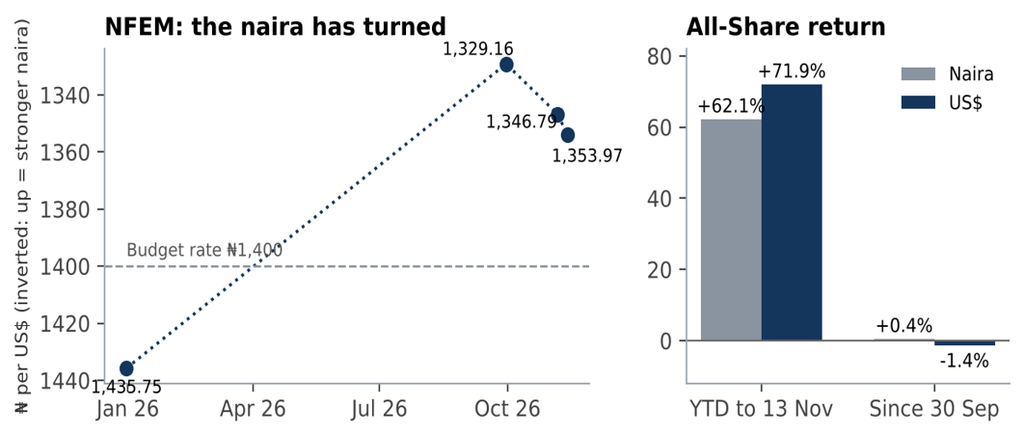
Source: Official CBN NFEM volume-weighted rates (30 Sep, 6 Nov, 13 Nov 2026); 31 Dec 2025 rate as reported by CSEA. NGX All-Share at 13 Nov. US$ return = (1 + naira return) x opening rate / closing rate − 1.
3. The shock in the equities market: unequal, and partly reversing
To 30 September the market rewarded direct exposure to the shock: Oil & Gas rose 134%, Industrial Goods 84% and Banking 79%, against 2% for Consumer Goods. In the six weeks since, the order has changed. Oil & Gas is down 5.0% with Brent below its late-October peak, Banking fell 12.8% amid elevated market yields and weaker sector earnings, although the move cannot be attributed to rates alone, and Consumer Goods is down 3.0%. The All-Share is up only 0.4%, held up by Industrial Goods (+18.6%), where Dangote Cement rose 9.6% on 9 November and held there through 13 November. The market rebounded 1.4% that week after a 2.1% fall the week before.
The pattern separates sentiment from earnings. Oil stocks that rose on the Brent headline are giving back gains, while Seplat’s case rests on barrels and deleveraging (Section 1). Cement and telecoms, where pricing power comes with cash generation, are holding up. Supply is a further risk. The Dangote Petroleum Refinery offer (₦525 a share; ₦2.15tn base offer) closed on 27 October. Reuters reported orders of about ₦6.4tn, citing sources familiar with the offer; this is not the final SEC-approved allotment. At the offer price the company would be worth about ₦65tn, and a listing of that size could draw funds from existing large caps.
As at 16 November, neither the basis of allotment nor a listing date had been published, and the official portal showed applications still under verification. Under the revised indicative timetable, SEC no-objection is scheduled for 17 November; the allotment announcement, refunds, CSCS crediting and NGX listing (about 15 business days after allotment) would follow.
Exhibit 8. The early winners are giving back gains
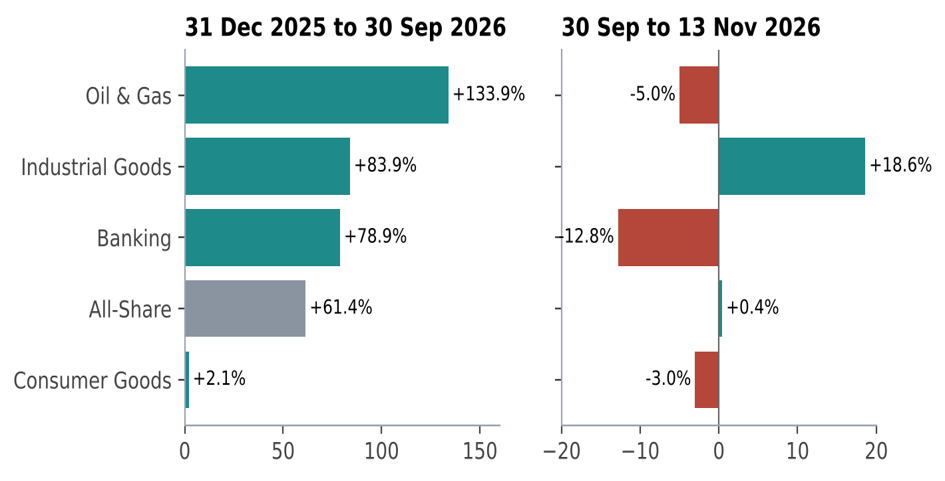
Source: NGX index levels: NGX daily market report (13 Nov 2026); 31 Dec 2025 and 30 Sep 2026 via Nairametrics citing NGX. Returns calculated by Springhill Capital.
4. Conclusion: what investors should do and watch
The bill arrives in stages: first in household volumes, then in rates, then in valuations. The equity market appears to be entering the third stage. We would not chase oil-price beta or rate-sensitive banks, and we would size even our preferred names with valuation in mind. We prefer companies that pass three tests:
1. Nominal revenue growth above headline inflation: a screen, not a full measure of real growth, which also depends on volume, mix, geography and company-specific input prices.
2. Durable margins: margin gains that do not rely on the volume squeeze or one-off finance-cost relief.
3. Balance-sheet protection: net cash or falling debt, so higher-for-longer rates do not erode earnings.
Exhibit 9. Resilience test and desk view
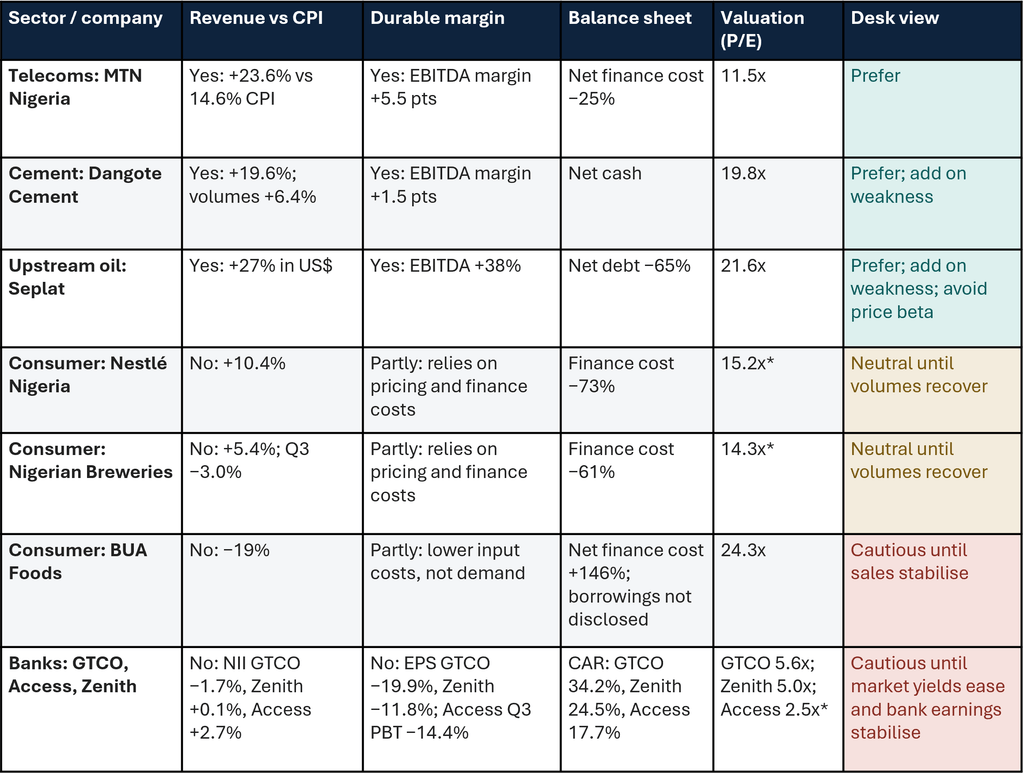
Source: company filings; NGX closes, 13 Nov 2026. P/E on trailing EPS; *indicative P/E based on annualised 9M 2026 EPS (Nestlé, Nigerian Breweries, Access; for Nigerian Breweries, sales peak in Q4). NII = net interest income. CPI comparison uses September headline (14.63%) to match the 9M period.
Exhibit 10. What to watch, and what would change our view
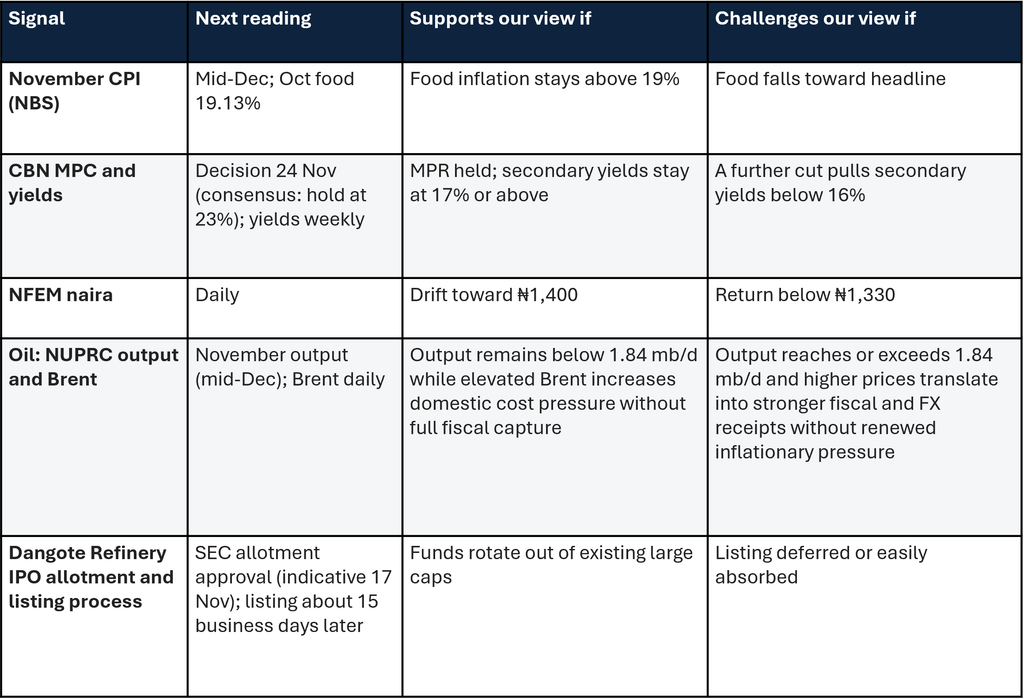

Data notes. Evidence cut-off 13 November 2026. Brent: ICE front-month futures settlements (January 2027 contract from 9 November). NFEM: official CBN volume-weighted rates; the 31 December 2025 rate (₦1,435.75, CSEA) could not be independently classified, so the YTD US-dollar return is indicative. Sovereign benchmark: FGN March 2036 secondary yield (FMDQ, 12 November). CPI is to October 2026 (NBS, 16 November). Due after publication: the 24 November MPC decision and the Dangote Refinery allotment. Important disclosure: for information and research purposes only; not an offer or solicitation. Desk views express relative positioning, not formal ratings or price targets. Past performance does not guarantee future results.
Kindly find the Report Below
Thanks for reading.