

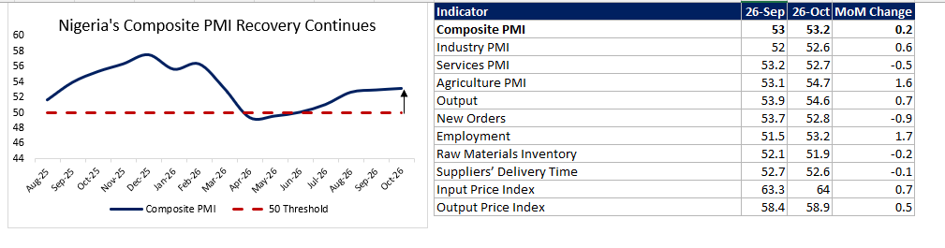
The composite Purchasing Managers’ Index (PMI) edged up again to 53.2 points in October from 53 points in September, extending the expansion in Nigeria’s private sector activity to five consecutive months. The improvement came largely from stronger activity in industry and agriculture, while activities in services recorded a slight moderation. Looking at the 32 subsectors surveyed by the CBN, 24 recorded expansions, suggesting that the recovery remains fairly broad based, although the pace of improvement differs across sectors.
Source: CBN, SPH Equities Trading Desk
Business activities improves, but the Demand and Margin story remains mixed
In our understanding, what stands out in October is the improvement in output and employment, even as new orders moderated. The composite output index increased by 0.7 points to 54.6, while Employment recorded a stronger improvement of 1.7 points to 53.2. However, New Orders declined by 0.9 points to 52.8, and raw-material inventories eased slightly to 51.9. Putting in simple terms, businesses were producing more and employing more people but fresh orders did not grow at the same pace. This creates more concern because sustained production growth would eventually require stronger demand to absorb additional output.
Looking at Industry, it provided a stronger contributed to the improvement, with the it’s PMI rising to 52.6 points from 52, marking a third consecutive month of expansion. Twelve of the sixteen industrial subsectors recorded growth, while four contracted. Cement remained the strongest performing subsector at 60.2 points, while Chemical and Pharmaceutical Products recorded the weakest reading at 43.4 points. The improvement was supported by higher output, new orders, employment and raw-material inventories. Employment, in particular, improved to 52.7 points from 51.1, suggesting better operating conditions across the sector. A relatively stable exchange rate could provide further support to manufacturers by making the cost of imported raw materials and machinery more predictable. Also, a stronger naira can also reduce the local currency cost of imported inputs, particularly for businesses that depend heavily on foreign supplies. However, the benefit will not be the same across all companies. Manufacturers with significant domestic energy and logistics costs may continue to face pressure, even if exchange-rate conditions improve. In other words, currency stability helps, but it does not automatically translate into better margins.
Services, on the other hand, lost some momentum, with its PMI easing to 52.7 points from 53.2 in September. The sector nevertheless remained in expansion for the fourth consecutive month. Seven of the eleven subsectors surveyed recorded growth, while four contracted. Educational Services remained the strongest-performing subsector at 60.2 points, while Arts, Entertainment and Recreation recorded the lowest reading at 47.1 points. More importantly, New Orders declined to 51.7 points, while inventories eased to 51.1 points. This tell us that although services businesses continued to expand, the pace of incoming demand weakened as household purchasing power offers part of the explanation because falling inflation does not necessarily mean that prices are falling.
Consumers are still dealing with the cumulative increase in food, energy and transportation costs, even as the rate of price increases moderates. This means that households may remain cautious with their spending, particularly on non-essential services. For businesses, the challenge is not just attracting customers, but convincing consumers to spend more in an environment where disposable income remains under pressure.
On Agriculture side, it was the strongest-performing sector in October, with its PMI rising to 54.7 points from 53.1, extending its expansion to 27 consecutive months. All five agricultural subsectors recorded growth, with Livestock leading at 56.4 points and Agricultural Support Services recording the lowest reading at 52.0 points. General Farming Activities increased to 56.8 points, while New Orders rose to 55.6 points, pointing to stronger production and demand conditions. However, the cost side of the story remains a concern. The sector’s input price index stood at 68.3 points, considerably higher than its output price index of 61.1 points. This suggests that agricultural businesses are still dealing with significant input-cost pressures, which may limit the benefits of higher production. It also explains why stronger agricultural activity does not automatically translate into lower food prices. We believe that improvements in productivity, power supply, roads and storage are necessary to reduce costs across the agricultural value chain. Without these improvements, higher production may not fully translate into more affordable food for consumers.
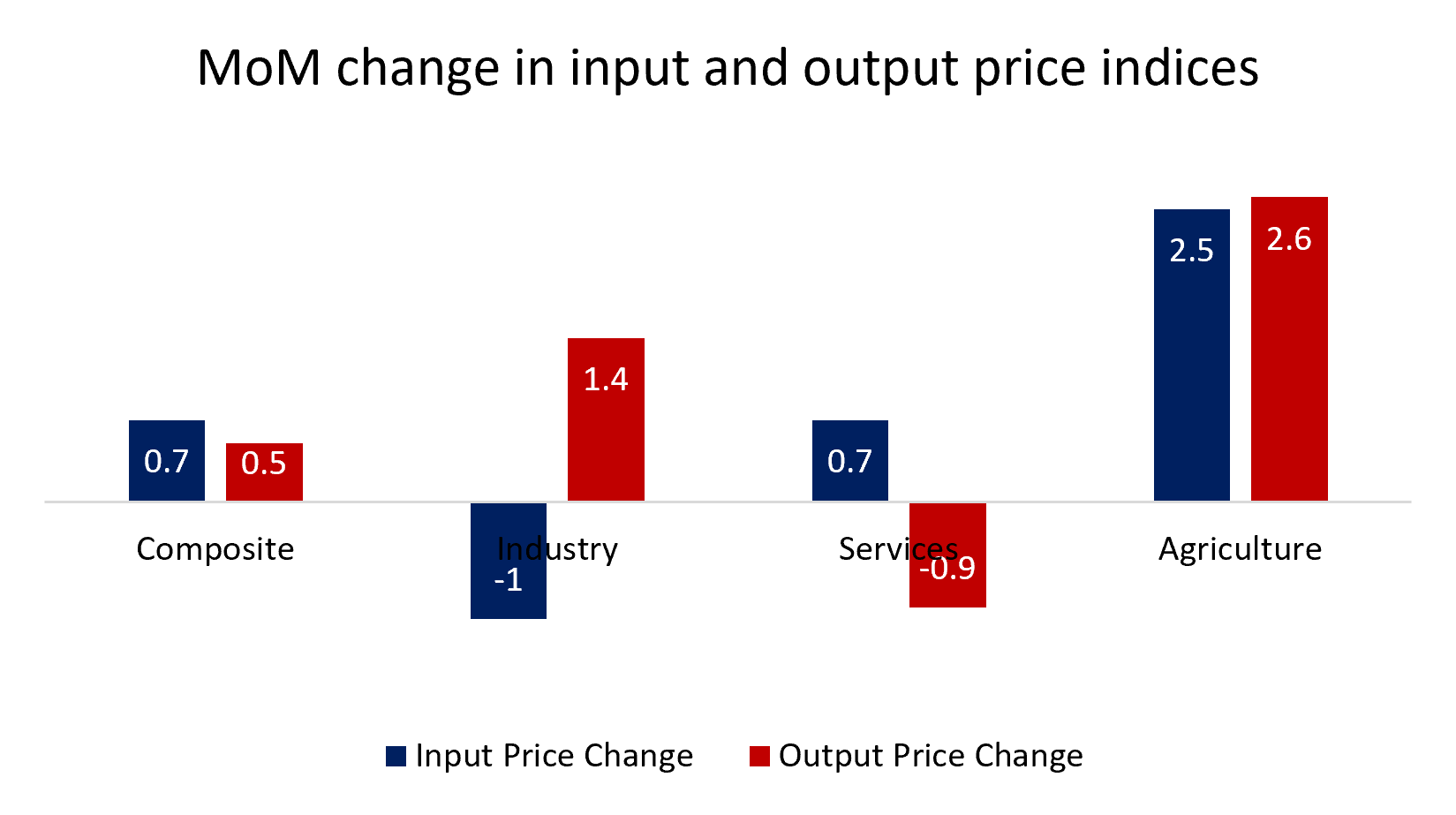
The cost picture remains one of the major concerns in the October survey. The Composite input price index increased by 0.7 points to 64.0, while the output price index rose by 0.5 points to 58.9. Although businesses continued to adjust their selling prices, input costs remained more elevated, suggesting that firms may not be passing the full increase in operating costs to customers. The sectoral breakdown is particularly revealed this. Industry recorded a 1.0-point decline in input prices alongside a 1.4-point increase in output prices, which could offer some relief to industrial margins. Services presented a less favourable picture, as input prices increased by 0.7 points while output prices declined by 0.9 points. In Agriculture, both indices increased, by 2.5 and 2.6 points respectively, although input prices remained substantially higher. This is where the pricing dilemma facing businesses becomes important. Raising prices too aggressively can push customers away and weaken sales volumes, while absorbing higher costs can gradually erode margins. Businesses must therefore find a balance between protecting volumes and maintaining profitability. For investors, this is an important reminder that stronger business activity does not always translate into stronger earnings.
Implications for Equities
The October PMI provides a fairly constructive signal for companies exposed to domestic economic activity, particularly those in the industrial, construction and agricultural value chains. The continued expansion in Industry, alongside stronger output and employment, should provide support for revenue prospects across selected industrial companies. Cement producers such as Dangote Cement, HBM and BUA Cement remain well positioned to benefit from improving construction and industrial activity, provided demand is sustained. The stronger Agriculture reading also points to improving activity across the agricultural value chain, although elevated input costs remain a concern for profitability.
For consumer-facing companies, the picture is less straightforward. The moderation in Services and weaker new-order momentum suggest that demand recovery may take time. The festive season could provide some support to sales volumes, but constrained household purchasing power may limit the extent of the improvement. Companies with strong distribution networks, flexible pricing strategies and better cost management are likely to be in a stronger position to protect both sales volumes and margins.
Exchange-rate stability is another factor worth watching. A more stable naira could benefit import-dependent manufacturers through lower and more predictable input costs. However, companies with significant export exposure may experience a different impact, as foreign-currency earnings translate into fewer naira when the local currency strengthens. The effect will therefore depend on each company’s import exposure, export earnings and ability to manage operating costs.
Ultimately, the margin story remains mixed. While easing industrial input prices may provide some relief to manufacturers, persistent cost pressures in Services and Agriculture could weigh on earnings. This makes it important to look beyond revenue growth when assessing corporate performance. The companies best positioned to benefit from the improving economic environment will likely be those that can grow volumes, maintain pricing power and manage costs effectively.
Overall, October’s PMI points to a gradual improvement in economic activity, but the moderation in new orders and persistent input-cost pressures suggest that the recovery is not yet on entirely firm ground. The next thing to watch is whether stronger output and employment can translate into sustained demand growth and, more importantly, improved corporate earnings.
Kindly find the Report Below
Thanks for reading.