


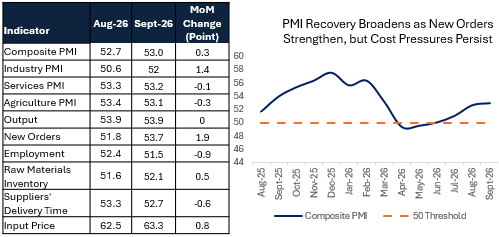
The Composite Purchasing Managers’ Index (PMI) rose again to 53.0 points from 52.7 in August showing more strength in Nigeria’s private-sector activity. The improvement was broad-based across the three major sectors (Industry, Services and Agriculture and are above the 50-point threshold). Out of 32 subsectors surveyed by the CBN, 23 recorded expansions, pointing to a broader recovery in business activity as the economy enters the final quarter of the year.
Source: CBN, SPH Equities Trading Desk
The more important catch in our understanding, was the improvement in new orders. The composite New orders index rose by 1.9 points to 53.7, recording the strongest m/m improvement among the major components. Output remained at 53.9 points, while raw-material inventories improved to 52.1 points. This suggests that the September improvement was increasingly supported by stronger demand and order flows, rather than simply higher production. Employment, however, moderated to 51.5 points from 52.4, indicating that the recovery has yet to translate into a stronger pace of labour demand.
Industry provided the strongest positive surprise as the Industry PMI rose to 52.0 points from 50.6, marking a second consecutive month of expansion and the strongest improvement among the three major sectors. Ten of the sixteen industrial subsectors recorded growth. Manufacturing also returned further into expansion at 51.7 points, while Basic Metal, Iron & Steel, Food, Beverage & Tobacco, Oil Refining, Pulp & Paper and Wood & Wood Products remained in expansion. Construction also moved above the 50-point threshold to 50.7.
Services remained resilient at 53.2 points, broadly unchanged from 53.3 in August, while Agriculture moderated marginally to 53.1 from 53.4 but extended its expansion to a 26th consecutive month. The breadth of the recovery is therefore encouraging, although the pace remains moderate. Importantly, the Composite PMI at 53.0 is still below the 54.0 recorded in September 2025 and the 57.6 peak recorded in December 2025, suggesting that the current recovery is strengthening but has not yet returned to the levels seen during the stronger phase of activity late last year.
The key concern remains cost pressure. The Composite input price index increased by 0.8 points to 63.3, while the output price index declined by 0.5 points to 58.4. This widening gap suggests that businesses are facing renewed pressure from input costs especially from energy prices while their ability to fully pass those costs on to customers is moderating. For corporates, the implication is that stronger volumes and new orders may not immediately translate into stronger margins. The CBN itself noted that the renewed build-up in input-price pressures warrants close monitoring.
On inflation leg, the August inflation report showed headline inflation at 15.39%, monthly inflation at 0.71% and core inflation at 13.29%, with core inflation turning negative month-on-month. The decision therefore comes against a backdrop of improving disinflation, giving the CBN more room to begin reducing the restrictiveness of monetary policy.
Implications for Equities
As the equities market is currently anticipating the release of Q3 earnings, and the September PMI provides a more constructive signal for domestic-demand and industrial-facing companies. The improvement in new orders, the return of Industry to expansion and continued growth in Services and Agriculture point to improving underlying business activities. This should support revenue growth for companies exposed to domestic consumption, construction, manufacturing and broader economic activity, particularly if the improvement in demand is sustained into the fourth quarter. Within the industrial space, we see companies such as Dangote Cement, HBM Nigeria, BUA Cement etc as potential beneficiaries of improving construction and industrial activity, while stronger domestic demand with support of festive period should also provide a supportive backdrop for selected consumer-facing companies like Unilever, Nascon, PZ, NB, Guiness etc. However, we shouldn’t forget the margin story which remains mixed. The increase in input prices alongside softer output-price growth means companies may continue to face pressure on gross margins, particularly in sectors where pricing power is limited. This makes volume growth, cost efficiency and balance-sheet strength increasingly important in assessing which companies can convert the broader economic recovery into earnings growth.
In conclusion, the September PMI also comes shortly after the CBN’s 350bps MPR reset to 23%, which should gradually lower the cost of money and provide additional support to business activity. The combination of improving new orders and easier monetary conditions is positive for businesses, but the transmission to corporate earnings will depend on how quickly lower financing costs feed through to businesses and whether the current improvement in demand we are seeing can offset input-cost pressures.
Kindly find the Report Below
Thanks for reading.